_
Thoughts from a guy trying to embrace mystery and the myriad of emotions that make up this messy and beautiful thing called life.
Friday, May 4, 2012
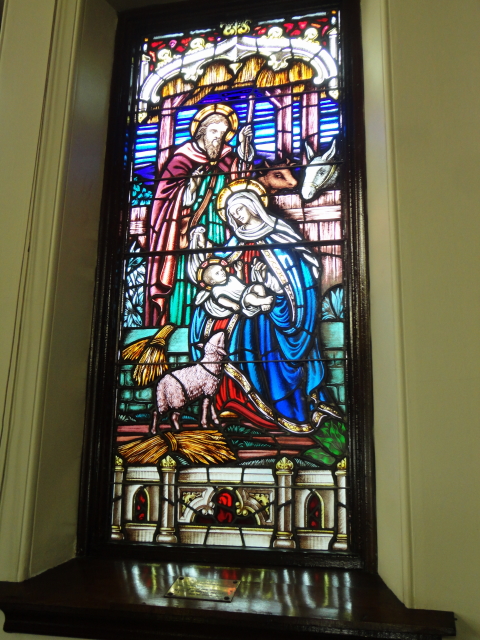
The Mosaic That Shows Us The Face Of God
"A mosaic consists of thousands of little stones. Some are blue, some are green, some are yellow, some are gold. When we bring our faces close to the mosaic, we can admire the beauty of each stone. But as we step back from it, we can see that all these little stones reveal to us a beautiful picture, telling a story none of these stones can tell by itself.
That is what our life in community is about. Each of us is like a little stone, but together we reveal the face of God to the world. Nobody can say: "I make God visible." But others who see us together can say: "They make God visible." Community is where humility and glory touch."
~ Henri J.M. Nouwen
CHURCH SPOTLIGHT: Emmanuel United Church (Waterloo, Ontario)
May 3, 2012
Today I had the privilege of sitting down with Rev. Dr. Bruce Sweet, minister at Emmanuel United Church in Waterloo, Ontario. We discussed the local congregation, the United Church of Canada, as well as theology and the Christian Church in general.
| The Hearth Room |
| The Fellowship Hall |
Emmanuel United Church
Sunday Services @ 10:00a.m.
22 Bridgeport Road West
Waterloo, Ontario
http://emmanueluc.ca
519-886-1471
22 Bridgeport Road West
Waterloo, Ontario
http://emmanueluc.ca
519-886-1471
Tuesday, May 1, 2012
Monday, April 30, 2012
Losing And Gaining Our Lives
"The great paradox of life is that those who lose their lives will gain them. This paradox becomes visible in very ordinary situations. If we cling to our friends, we may lose them, but when we are nonpossessive in our relationships, we will make many friends. When fame is what we seek and desire, it often vanishes as soon as we acquire it, but when we have no need to be known, we might be remembered long after our deaths. When we want to be in the center, we easily end up on the margins, but when we are free enough to be wherever we must be, we find ourselves often in the center.
Giving away our lives for others is the greatest of all human arts. This will gain us our lives."
~ Henri J.M. Nouwen
Giving away our lives for others is the greatest of all human arts. This will gain us our lives."
~ Henri J.M. Nouwen
Saturday, April 28, 2012
Did Jesus Rise From The Dead? (A Church Without God - Chapter V)
Rev. Ernest Harrison dedicates the fifth chapter of his controversial book from 1966 A Church Without God to the topic of Jesus' resurrection. He begins by stating that "the new Christian is called upon to face a living relationship with Jesus Christ, and he does so in terms of resurrection." He then says that it is important to look at the Biblical account and how we interpret the resurrection story.
Harrison begins by pointing out some discrepancies in the Biblical resurrection stories.
Harrison argues that for Paul and for many of today's (1966) Christians, the resurrection was an eternal now, not something in the past or future. "But if you ask me to believe that my body or my personality will somehow come alive again beyond the grave, you ask me to believe something that eludes me - something that I can no longer accept.
Harrison knows that there are plenty of Christian who take the resurrection accounts literally and believe in an after-life, and says that "in the pluralism of modern Christianity, there is no reason why one should try to win over another group to one's own convictions."
Harrison continues by saying that the best evidence for the historical nature of the resurrection events is the change that took place in the life of the apostles. After the crucifixion, the apostles were weak and timid and met in secret. After Pentecost they became courageous leaders in the Church. Harrison then cites a book from 1956, When Prophecy Fails, which suggests the following. "Suppose an individual believes something with his whole heart; suppose further that he has a commitment to this belief and that he has taken irrevocable actions because of it; finally, suppose that he is presented with evidence unequivocal and undeniable evidence, that his belief is wrong; what will happen? The individual will frequently emerge, not only unshaken, but even more convinced of the truth of his beliefs than ever before. Indeed, he may even show a new fervour for convincing and converting other people to his view." Harrison then goes on to say that there have been many events that have never taken place, still many followers remain faithful. In the 2nd century, Montanus declared that the Second Coming was at hand, and though it didn't occur, many still believed. He cites forecasts by the Jehovah's Witnesses as another example. A modern day example is the radio evangelist Harold Camping, who predicted the end of the world on a certain day, and when it didn't happen, he claimed that forces had shifted and that the end would come a few months later (we're still here).
Harrison says that one possibility is that after a period of grieving for Jesus, the disciples turned their despair (the cross) into a success, saying that it was the ultimate triumph. Still, he writes,
-------------------------------------------
The Easter story used to mean a huge deal to me when I was a fundamentalist Christian. It was a given that Jesus died, was in the grave for 3 days, after which he bodily rose from the dead. After I left fundamentalism, I didn't quite know what to think of the Easter story, and that was just fine with me. Eventually I became involved with a movement called Unity, which re-interprets the Easter story in its own way, though my mind couldn't really work its way around that either. Today I believe that Jesus lived in such a contrary way to other religious and political leaders of his day that they considered him a threat and killed him. I honestly don't know what to make of the resurrection. It stirs excitement to think that a man can be raised from the dead. As far as my personal resurrection goes, I agree with Harrison and others that it is "the eternal now" and not something that happens when I die. While I do not believe that my body will be physically resuscitated, I do believe that somehow, in some way, my spirit will live on.
And that's enough for me.
Harrison begins by pointing out some discrepancies in the Biblical resurrection stories.
- The women who are to visit the tomb buy their spices and perfume on Friday, according to Luke; on Saturday evening, according to Mark.
- The women who visit the tomb are described differently, as is the whole episode. In Matthew, two women, the two Marys - come; there is a violent earthquake; an angel descends from heaven, rolls the stone back, and sits on it; there are guards who shiver with fear; the angels tell the women what to do. In Mark, three women - the two Marys and Salome - bring the oils, see the tomb empty, and enter to find a youth wearing a white robe sitting on the right side; he tells them what to do. In Luke, three women - the two Marys and Joanna - bring the spices, find the stone rolled away from the tomb, and enter to find two men in dazzling garments at their side who tell them what to do. In John, the embalming is not done by the women at all, but by two men - Joseph and Nicodemus
- Matthew and Luke appear to refer to the resurrection appearances as occupying a single day; John gives an account that spreads them over more than eight days; Acts fixes the period at forty days.
Harrison continues by stating the possibility that Christians came up with the empty-tomb story to counter rumours that they themselves had taken the body of Jesus. In any case, "the resurrection stories need not be taken as factual." Harrison says that it is no surprise that Paul, while arguing for the resurrection, never mentioned the empty tomb. He surmises that the later gospel accounts beefed up the empty tomb story to back up the resurrection claims.
He then goes on to say that "If we are not committed to taking these narratives of the empty tomb and the appearances to the disciples as precise recordings of events, we are liberated to enter a deeper response. If the writer is trying to spell out the underlying meaning of the story, then we have to meet him at a more personal level than if he is simply reciting a series of incidents."Harrison says that while everyone living on the planet believes in death, the promise of an afterlife is becoming less believable, even to Christians. He unequivocally says that "it is a doctrine that has no meaning." I must say that personally, I have not given much thought to the after-life for many years. This is in no doubt due to the fact that I used to worry about Hell so much when I was a fundamentalist Christian that it was a relief when I gave that belief system up to no longer have to worry about burning.
Harrison argues that for Paul and for many of today's (1966) Christians, the resurrection was an eternal now, not something in the past or future. "But if you ask me to believe that my body or my personality will somehow come alive again beyond the grave, you ask me to believe something that eludes me - something that I can no longer accept.
Harrison knows that there are plenty of Christian who take the resurrection accounts literally and believe in an after-life, and says that "in the pluralism of modern Christianity, there is no reason why one should try to win over another group to one's own convictions."
Harrison continues by saying that the best evidence for the historical nature of the resurrection events is the change that took place in the life of the apostles. After the crucifixion, the apostles were weak and timid and met in secret. After Pentecost they became courageous leaders in the Church. Harrison then cites a book from 1956, When Prophecy Fails, which suggests the following. "Suppose an individual believes something with his whole heart; suppose further that he has a commitment to this belief and that he has taken irrevocable actions because of it; finally, suppose that he is presented with evidence unequivocal and undeniable evidence, that his belief is wrong; what will happen? The individual will frequently emerge, not only unshaken, but even more convinced of the truth of his beliefs than ever before. Indeed, he may even show a new fervour for convincing and converting other people to his view." Harrison then goes on to say that there have been many events that have never taken place, still many followers remain faithful. In the 2nd century, Montanus declared that the Second Coming was at hand, and though it didn't occur, many still believed. He cites forecasts by the Jehovah's Witnesses as another example. A modern day example is the radio evangelist Harold Camping, who predicted the end of the world on a certain day, and when it didn't happen, he claimed that forces had shifted and that the end would come a few months later (we're still here).
![]() |
| Evangelist Harold Camping |
"The significance of the resurrection is great. In their rationalizations to prove that the cross instead of a defeat had really been a victory, the apostles were not rationalizing from an absurd belief into an absurd alternative. The death on the cross was real. Jesus died. His death was inevitable, given the circumstances of a rebel who opposed the leaders of church and state and stirred up the people into independence. It had always happened before; it will always happen again. He declared himself to be truly and fully man, and he got in the way of those who wished to use men and ride them to their own advantage. He was truly man, and he died."Harrison says that how much of the resurrection stories stem from the apostles' rationalizations "we shall never know. Rationalizing, though it may be observed as an attempt to escape dissonance, may produce a consonance which is true in itself and to life." Basically Harrison is saying that even though the resurrection may never have taken place, the story that built up after Jesus died carries on a life of its own, and this is not necessarily a bad thing. According to Harrison, "if the apostles, faced with a clear disconfirmation of the event they had expected, turned instead to a proclamation of resurrection, then we have a greater support for the continual rising of the human spirit than the old interpretations."
-------------------------------------------
The Easter story used to mean a huge deal to me when I was a fundamentalist Christian. It was a given that Jesus died, was in the grave for 3 days, after which he bodily rose from the dead. After I left fundamentalism, I didn't quite know what to think of the Easter story, and that was just fine with me. Eventually I became involved with a movement called Unity, which re-interprets the Easter story in its own way, though my mind couldn't really work its way around that either. Today I believe that Jesus lived in such a contrary way to other religious and political leaders of his day that they considered him a threat and killed him. I honestly don't know what to make of the resurrection. It stirs excitement to think that a man can be raised from the dead. As far as my personal resurrection goes, I agree with Harrison and others that it is "the eternal now" and not something that happens when I die. While I do not believe that my body will be physically resuscitated, I do believe that somehow, in some way, my spirit will live on.
And that's enough for me.
The Humility Principle
"The Creator in Its wisdom has conceived principles that govern my life and the lives of everyone. One law of life I have recently discovered is the humility principle. '...for everyone who exalts himself wil be humbled, but he who humbles himself will be exalted' (Luke 18:14). This is not a law with which I can choose to interact. It is a principle, and therefore it is always active in my life. Either I humble myself, and I am exalted, or I exalt myself, and I am humbled.
I cannot decide to put this principle aside until I am ready to work with it. It is always working with me. However, I have a choice to make. I can choose to humble myself. At this point, I may not even know how to accomplish this, but there is something I can do today. I can choose not to exalt myself.
The best way to begin is to determine how I have exalted myself in the past. This is important because my tendency is to repeat these practices again and again."
~ Jim Rosemergy, "The Transcendent Life"
---------------------------------
More and more I feel like I am being called to live a simpler, more humble life. This is often not an easy choice to make, as there are a thousand distractions around me: TV, the internet, other entertainment activities, maybe even people. I think that while I often feel called to this kind of life and know that it is best for me and my spiritual life, I fear it because it leads to a stripping away. My preconceived ideas of what is best for me, what I should expect out of life, or from people are challenged again and again. Some of the people we admire the most lived their lives in humility and simplicity: Mother Teresa, Ghandi, Jesus. Yet I can't wait to get my hands on new music, movies, or to receive attention from those around me.
The humble, spiritual life is not an easy one, especially when you're just starting out, but it is through this life that we will find true healing and lasting peace.
I cannot decide to put this principle aside until I am ready to work with it. It is always working with me. However, I have a choice to make. I can choose to humble myself. At this point, I may not even know how to accomplish this, but there is something I can do today. I can choose not to exalt myself.
The best way to begin is to determine how I have exalted myself in the past. This is important because my tendency is to repeat these practices again and again."
~ Jim Rosemergy, "The Transcendent Life"
---------------------------------
More and more I feel like I am being called to live a simpler, more humble life. This is often not an easy choice to make, as there are a thousand distractions around me: TV, the internet, other entertainment activities, maybe even people. I think that while I often feel called to this kind of life and know that it is best for me and my spiritual life, I fear it because it leads to a stripping away. My preconceived ideas of what is best for me, what I should expect out of life, or from people are challenged again and again. Some of the people we admire the most lived their lives in humility and simplicity: Mother Teresa, Ghandi, Jesus. Yet I can't wait to get my hands on new music, movies, or to receive attention from those around me.
The humble, spiritual life is not an easy one, especially when you're just starting out, but it is through this life that we will find true healing and lasting peace.
Subscribe to:
Posts (Atom)